
Chapter 2: The Self
In which we ask who the hell we think we are

This is the second chapter of a book that currently has the working title Cataspectral. You can find the introduction and table of contents here.
Working together is critical to the human survival strategy, and this is likely the reason we developed abstract thinking in the first place. In order to work together with another person – to make a plan at the outset of a hunt, for example – you have to be able to model the private experiences, thoughts and other states of the other person’s mind. This is called ‘theory of mind’ or ‘mentalizing’. Humans are adept at mentalizing, with adults usually being capable of doing so up to the fifth order (“I know that you think that I think that she knows we don’t believe her”).
The brain constructs the self from moment to moment, relying significantly on this capacity for mentalizing. At this moment, I’m sitting at my computer in a coffee shop in New York on a Sunday afternoon. My body is a physical object in a particular location at a particular moment in time. I break my attention away from writing and reflect, and I become aware of being this body, at this moment. Suddenly, I have a pang of foreboding about waking up early tomorrow and making the commute to the office. I can practically feel the morning chill and the press of bodies in the packed subway car. My body is one physical object at one location and time, simulating the internal state of a different physical object (my future body) at a different location and time, which reflexively causes my body at this moment and location to experience a negative emotional sensation. Why does me now, this specific object, have a particular interest in simulating the experiences of this different object? The answer is that the present object and the future object are different instances of an ongoing process strung out along a single causal chain – they are both moments in the history of my life and are thus part of what ‘me’ means. The same is true of the past, in that remembering what you felt in some moment is also modeling the internal experience of a different body, but memory refers to a different stage of the modeling process. Instead of constructing a model that has yet to be tested by experience, the act of remembering accesses an already-existing record that may be worn or modified by time. Thinking of what I’ll feel in the future seems more similar to thinking of what another person feels, since in both cases there is an obvious level of uncertainty; thinking of what I felt in the past can seem less uncertain, since I might have a memory of that feeling, but we should be careful not to overestimate our accuracy. For instance, it is well documented that courtroom eyewitness reports are often the product of distorted recollections.
Just as I can see another collection of cells as a unified entity across spacetime that was born, now lives and will die, so I can see myself. Past-me and future-me are both different physical entities toward which I am applying theory of mind. To have a self is to be a body applying theory of mind to a different body that is part of its causal history in the past or future and seeing these bodies as the same in an important sense. The sets of molecules of myself as a toddler and myself now are related across time by a succession of causes and effects that is selectively recalled or projected and told by myself to myself: the story of my life.
This relatively common experience of selfhood is malleable in diverse ways. Once you become aware of how the self is constructed, it becomes possible to reverse-engineer this process and deconstruct the self by focusing only on the present moment to the exclusion of the narrative structure. By refusing to identify thoughts or feelings that come into awareness as your “own,” instead simply observing them nonjudgmentally as they arise and fade away once more, you will find that the self begins to shrink. For some people, no meditative effort is even necessary. The philosopher Galen Strawson, for example, reports that he naturally lacks a narrative sense of self, although he does not argue from this that all such selves are illusory, simply that he lacks one.1 Just as it is possible to deconstruct the idea of one’s personal selfhood by focusing on the present moment to the exclusion of any past or future, it is possible to expand the idea of the self by mentalizing with respect to larger-scale entities in space or time that include one’s body. In the temporal dimension, you can observe that the causal chain linking your current self to your future self is a small portion of a causal chain stretching backward (and perhaps forward) for millions of years through reproduction to other people and, eventually, all life on the planet. You can also mentalize spatially, observing that you are part of causal interactions with others in your community, forming a network much larger than yourself that can be seen as a kind of super-self.
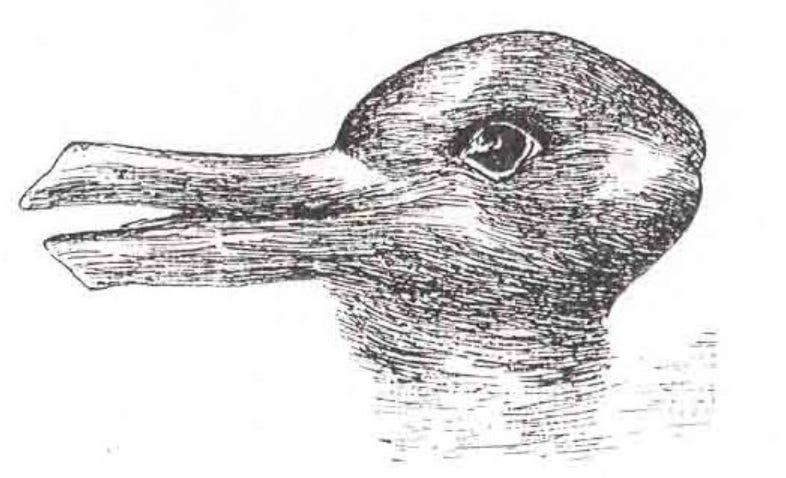
Some people, like Strawson, find it easier to see themselves as a single system state at any given time, others find it easier to see themselves as a small part of larger-scale entities like nations or ancestral lineages. The self, then, is best understood as a multi-faceted reality, in which one can see an arbitrary set of different moments of awareness, a limited series of moments bounded by birth and death, or one small part of a larger process or entity, depending on one’s focus. Like the famous illustration below, which can be either a rabbit or a duck, the self is capable of many different, equally legitimate interpretations.
Things that Bother Me. New York Review of Books, 2018, pp. 34-35.