
Chapter 3: What Do We Mean By 'Meaning'?
In which we look at our bellybuttons


This is the third chapter of a book that currently has the working title Cataspectral. You can find the introduction and table of contents here.
Since selfhood is to at least some degree socially constructed, anybody whose cataspect includes selfhood as an important component will require engagement with others, whether that means interacting face-to-face with a group of humans or with larger entities like God or country. It is well known that humans require social bonds, some more than others, but to such a general extent that solitary confinement is widely considered to be torture or at least punishment. Simply put, we need to feel that we matter to other people, to be in communion with a tribe; if we feel isolated, we experience significant psychological distress. This makes sense, as being all alone in the ancestral environment was a profoundly dangerous situation, leaving a person threatened by exposure, hunger and predation. For symbol-using creatures like ourselves, it isn’t surprising that the need to matter to other people could be expanded to a more abstract need to matter in the grand scheme of things. This is what I will mean when I say that outward lenses can provide something called ‘sacredness’, which is a type of ‘meaning’, a word too often left vague, as a stand-in for some kind of “missing” spiritual vibe. To avoid such vagueness, I will now run the risk of going too far in the opposite direction by spending just over 2,500 words in the interest of definitional precision.
When we use the word ‘meaning’ in everyday life, the word means one of three things: volition (e.g., “that’s not what I meant to do”), reference (e.g., “the word ‘bachelor’ means ‘unmarried man’”) and mattering (e.g., “my wife means a lot to me”). Before trying to answer the question of sacredness, or what we’re gesturing at when we use a phrase like “the meaning of life,” we will need to disambiguate these and see how they work together.
In 1948, Claude Shannon, often hailed as the father of information theory and the digital age, published the classic paper “A Mathematical Theory of Communication”, in which he popularized the use of the term ‘bit’ to denote the most basic unit of information: an ON or an OFF, or a 1 or a 0. Shannon defines information by way of entropy. The thermodynamic notion of entropy means the level of unpredictability of a system; this entropy will decrease if external work is done on the system to bring it into a lower-likelihood state. Similarly, Shannon’s use of the entropy concept in information theory refers to the unpredictability inherent in a transmission medium; the more random, independent permutations a system can take on, the higher its entropy. The information of a given permutation of the medium is defined as how surprising that permutation is, which depends on how many other equally probable permutations did not occur. For example, getting a heads when you flip a coin is less surprising than rolling a snake eyes with a pair of dice, since there’s a 1/2 chance of rolling heads but only a 1/36 chance of rolling snake eyes, and thus each roll of the dice has more Shannon information than each flip of the coin.
Shannon is careful to separate his discussion of how to convey messages from the particular meaning of any messages you may send. Philosophers often refer to this as the difference between semantics, which he is not focusing on, and syntax, which is his object of inquiry. When I ask what a sentence means, I am asking a question about semantics, referring to the message the words convey. If I instead ask how the words work together under the rules of the English language to be capable of conveying any message, rather than the particular message conveyed by that sentence, I am asking about syntax. While semantics are the target for us here, since we are after all talking about the three senses of ‘meaning’, syntax is also critical, since it is a prerequisite for semantics. Shannon information, since it is fundamentally syntactical and agnostic as to semantics, is best understood as the potential of any given state of a medium (e.g., a heads or a snake eyes) to send a message.
But what exactly is the difference between a series of physical events that constitutes a message and a series of physical events that does not? To answer this, it will be helpful to define the terms ‘signal’ and ‘noise’. A common saying in information theory is, “one man’s signal is another man’s noise.” For Shannon, ‘signal’ refers to a particular series of permutations of the medium that must make it to the receiving end unchanged, while ‘noise’ refers to any source of randomness that can introduce errors into the original signal. But why must a given series make it to the end unchanged? This is the question Shannon specifically does not address: the question of semantics. The difference between signal and noise depends on what the sender and/or receiver are trying to do with the series of permutations they send and/or receive through the medium.
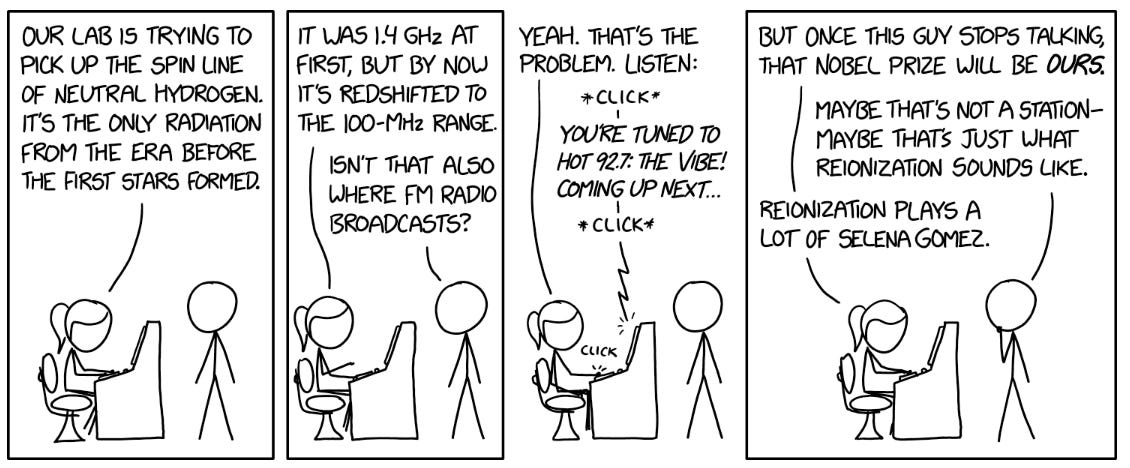
This comic strip illustrates the importance of reference, volition and interpretation in determining what is signal and what is noise. For most people, fluctuations in the frequencies around 100 MHz that deliver songs to radios are signal and any other fluctuations in that range are noise that must be filtered out, but for this scientist, the opposite is the case; for her, the radio signals are noise and the background radiation is the signal. ‘To refer to’ means, in the most basic sense, ‘to be correlated with’. To say that the word ‘car’ refers to a large machine with wheels, I am of course not saying these are identical. One is a series of sounds coming from my mouth and the other is a hunk of metal, glass, plastic and rubber. Reference in this sense is socially constructed, in that all of us English speakers have agreed that the word ‘car’ is in some sense a stand-in for this large machine. All of language is arbitrary in this way. But reference isn’t always socially constructed. Each of the frequencies in the comic refers to something: the radio signal and the background radiation stand for – are correlated with – songs or certain characteristics of the early universe, respectively. The fact that fluctuations in frequencies around 100 MHz refer to Selena Gomez songs (which really dates this comic) is agreed upon by humans, but the fact that fluctuations in such frequencies refer to characteristics of the early universe is not, since that correlation is a matter of physics and would exist whether or not we were around to observe it.
The difference between this referential sense of ‘mean’, as in “the fact that the leaves are all turning orange and yellow means that the northern hemisphere is tilting away from the sun” or “the word ‘cat’ means ‘a cute fuzzy creature that likes to nap in puddles of sunlight’”, is distinct from the volitional sense, as in “I didn’t mean to say that.” This is potentially confusing, since this is often how the volitional sense is invoked – that is, with respect to the referential sense. When I tell my dad that I didn’t mean to say ‘I crashed my car through the highway embankment’ when I said ‘I crashed out on the highway’, I’m not primarily saying that the one phrase doesn’t refer to the other; clearly, the one could technically refer to the other, given the rules of the English language. What I’m principally saying here is that, when I said those words, my intention was to refer to an emotional outburst rather than an horrific car accident, not that those words actually do or do not refer in such and such a way. Since language is inherently ambiguous and socially constructed, I as a single English speaker don’t have the authority to say that my phrasing objectively refers or doesn’t refer to anything at all.
Ludwig Wittgenstein argued that “if we had to name anything which is the life of the sign, we should have to say that it was its use.”1 Elsewhere, he puts it slightly differently: “to imagine a language means to imagine a form of life.”2 When we speak, write or do anything in order to send a signal, we are meaning something in the volitional sense in that there is an end we are trying to achieve by using such a reference. The neuroanthropologist Terrence Deacon quotes another philosopher, Gregory Bateson, for the quip that information is “a difference that makes a difference.”3 This is consonant with Wittgenstein, who gives a memorable example of the principle of meaning as use:
“I want to play chess, and a man gives the white king a paper crown, leaving the use of the piece unaltered, but telling me that the crown has a meaning to him in the game, which he can’t express by rules. I say: “as long as it doesn’t alter the use of the piece, it hasn’t what I call a meaning.”4
But if meaning is use, then saying a thing presupposes that it will have an effect on the hearer. For a hearer to be capable of taking action on the basis of something said to them, they must be capable of interpreting the signal. In contrast, it does not necessarily require the capacity for interpretation to send a signal. When we decode 100 MHz frequencies using a car radio, we intend to hear music and are using the FM radio code to that end; in that case, the sender is capable of meaning (in the volitional sense) to send a signal and we are capable of interpreting that meaning. But when we listen to the background radiation of the universe, we are interpreting the residue of non-volitional processes. Signal can be sent without volition, but without interpretation, volition and reference are useless, and if Wittgenstein is right, to be useless is to be meaningless. In such cases, there can be no distinction between signal and noise. Without anyone to interpret correlations in the context of such interpreters’ goals, all correlations would be just as much noise as any other uncorrelated physical events, or rather whatever exists in a world in which there is no signal and thus no noise, since noise is defined as whatever isn’t signal. Without interpreters, there can be no signals. This leads us to the third sense of meaning, which is to matter.
This third sense is bound up in what exactly an ‘interpreter’ means (in the referential sense of ‘means’). Deacon offers a good definition: “a non-equilibrium process that is precisely organized with respect to both supportive environmental conditions and to some feature of that environment that tends to correlate with those conditions.”5 Let’s, as they say, unpack that. Deacon reaches the requirement of a non-equilibrium process by the following path: since (i)(a) Shannon information is the collapse of many possibilities into one actuality in a physical medium, (b) this will always involve the performance of physical work as required by the laws of thermodynamics, and (c) the only kind of thermodynamic system that can perform work is one that is not in equilibrium; it follows that (ii) any sender of information must be in thermodynamic disequilibrium. But, according to Deacon, merely being a non-equilibrium doesn’t go far enough, since to interpret means to be capable of recognizing a signal and taking action with respect to it, not simply to be capable of sending a signal. A star is a non-equilibrium process and thus creates huge amounts of Shannon information, but it can’t actually interpret any signals. For a difference to truly make a difference, there must be a value in service of which that difference matters.
In nature, we only see values arise in the context of certain non-equilibrium systems maintaining the conditions for their own continuity by using feedback mechanisms; that is, living organisms.6 Living organisms bootstrap value into existence by forming a boundary between inside and outside, by monitoring the conditions of the outside, and then by taking actions with respect to the outside based on those measurements that will maintain conditions in the outside favorable to the continuation of the inside. This is the formation of the most basic version of the self. Biologists call the state of optimum functioning for an organism ‘homeostasis’.7 Bacteria swimming away from toxic chemicals are maintaining homeostasis just as humans are when turning on the air conditioner (or sweating and opening a window, if you happen to live in Europe). What matters to a living being is whatever contributes to the maintenance of homeostasis, however roundabout that connection may be; usually, the closer the correlation between something and homeostasis, the more that thing matters to living beings. In this sense, you could say that the meaning of life is to go on living.
We have seen the referential sense of meaning, which is correlation. We have seen the volitional sense, which is use by a sender. Now we have the mattering sense, which is usefulness to an interpreter. From this point of view, the volition sense and the mattering sense reveal themselves as two sides of the same coin, both of which in turn make use of referential meaning. When we talk about meaning as in “I didn’t mean to do that,” we are talking about the intentions of a sender; when we talk about meaning as in “that means a lot to me,” we are talking about the values of an interpreter, which presumably flow into their intentions, and from there into the use of referentiality as a tool in service of such intentions.
As humans, our social cognition has become so advanced that we are capable of sharing a model of the world with others through language. This represents a fundamental leap in perspective. No longer is individual survival the sole source of meaning, and no longer is the viewpoint generated by the need for individual survival the only one. By using chains of reasoning (that is, by making use of the volition and reference senses of meaning), we are able to conceive of points of view outside of our own and understand that each may be just as valid as ours. To do so is to think objectively or, as the philosopher Thomas Nagel put it, to adopt the “view from nowhere.” In this way, humans are able to repurpose their evolved survival instinct, as well as social instincts such as the drive to care for children or to sacrifice oneself for one’s tribe, toward the conception of the existence of the self or the tribe in an abstract, objective world that transcends such entities, leading to new, transcendent goals.
We are thus able to see ourselves individually as mattering in a sense that goes beyond the simple directive to go on living, while maintaining some degree of independence as rational beings. Here, we reach a sub-type of selfhood that I will call ‘personhood’. A person is an interpreter that becomes aware by way of mentalizing that it exists as a self among other selves (whether or not those interpreters are capable of similar levels of mentalizing, e.g. we can have moral regard to the points of view of insects).8 In virtue of this, a person is an interpreter that is capable of being held morally responsible. We exist with respect to other persons as, ideally, symbiotes – able to predict one another sufficiently well to benefit from working together and to avoid one becoming parasitic on or otherwise destructive of the other, but not so good at such prediction that we become a single organism.
Major Works. Harper, 2009, p. 90.
Philosophical Investigations. Basil Blackwell, 1986, para. 19.
Deacon, Terence. “What Is Missing from Theories of Information?” Information and the Nature of Reality. Cambridge, 2014, p. 208.
Major Works 166-167.
Deacon 210.
LLMs don’t meet this requirement, since they don’t maintain their own environments in order to sustain self-similarity. If a computer algorithm ever does become capable of taking actions to maintain its own existence, we will have created a new form of life, and we can only hope it will not become an invasive species.
Homeostatic theories of consciousness have been defended by Deacon as well as by the neuroscientists Karl Friston, Anil Seth and Mark Solms. I generally agree with their propositions, but a discussion of what consciousness really is can and has taken up libraries of volumes. Just because I agree with these theorists (who each have differences among themselves) does not mean I necessarily disagree with people like Christof Koch, Giulio Tononi or Douglas Hofstadter, who approach the topic from a more functionalist and less affective side, though which I don’t believe are strictly contradictory to the former viewpoints and indeed which bear substantial resonances with them. As I said, I consider the vast topic of consciousness only partially relevant to my argument here, and therefore only include strictly necessary references to it without attempting a full-throated defense of one theory over another.
I distinguish this from the legal sense of the word ‘person’, which refers only to an entity with the ability to bear rights and duties and does not involve a related sense of selfhood. What I am discussing here is what lawyers refer to as “natural persons.”