
Chapter 7: Reformation
In which we profile two paradigmatic reformers

This is the seventh chapter of a book that currently has the working title Cataspectral. You can find the introduction and table of contents here.
In March 1455, Aeneas Silvius Piccolomini wrote breathlessly from Frankfurt to his friend Juan de Carvajal, astonished at what he had witnessed. He had just attended the exhibition by a man named Gutenberg of a number of books of the Bible, printed in remarkably neat and legible script, and apparently capable of being reproduced with inhuman rapidity. There were two facts of great relevance to this moment that Aeneas could not have known at the time: first, that he would later be known as Pope Pius II; second, that his successor of less than a century would see the collapse of Christendom as he knew it, due in large part to the invention of this “marvelous man seen at Frankfurt,” as he described Gutenberg in his letter.
In the 250-ish years since the Albigensian Crusade, the Church had gone about its business. This included such trivial matters as putting down the heresies of Lollardy in England and the Hussites in Bohemia but also involved contending with the catastrophe of the Black Death and desperately trying to push back Ottoman advances from the east. But none of this could compare with the paradigm shift that was to come in the wake of Gutenberg’s printing press. In 1517, Martin Luther (apocryphally) nailed his Ninety-five Theses to the door of All Saints Church in Wittenberg. About 30 years after that, Nicholas Copernicus published On the Revolutions of Heavenly Spheres, a book which Galileo Galilei defended in his 1610 book, Starry Messenger. Luther and Galileo were very different people with very different missions, but in the eyes of the Church, the chief thing they were was heretics. And as we know, the way closed Debunkers deal with heretics is to suppress their ideas, one way or another.
Luther
Martin Luther was supposed to be a lawyer. His father, a miner, impressed upon him the need to have a stable source of income. But this was all derailed in 1505, when Luther was caught in a terrible thunderstorm and cried out to St. Anna (the patron saint of miners) to save him, promising that he would become a monk if she did. Insecure already about his salvation, he was perhaps happy to have an excuse to join a monastery and devote his life to God, despite his parents’ disappointment.
By 1513, he was a professor of theology at the University of Wittenberg. Here, he developed an understanding of the Bible that contravened Catholic orthodoxy, though he was not alone in this. For years, the humanist style of inquiry, with its motto of ad fontes! (“to the sources!”) had been growing in popularity within academia. Old-style scholasticism in the vein of Thomas Aquinas was seen as increasingly passe, and new lectures on St. Augustine and St. Jerome were all the rage, drawing on original sources rather than later commentaries. An important component of academic faculties at the time were what were known as theses of disputation, which required a student to defend propositions reflecting the teacher’s views in a kind of ritualized academic combat. In these contests, a certain level of license was permitted, since ideas could be floated with the understanding that they weren’t necessarily being defended for their truth value. Luther was not content leaving such disputations locked within the Wittenberg walls. Instead, he took a radical step.
On Halloween of 1517, he posted the Ninety-five Theses, and sent copies around to a small circle of friends. Somehow, whether by Luther’s hand or not, the Theses then went through a number of printings, finding their way throughout Germany within two months, and as far as England and France by early 1518. Later in 1518, he published his Sermon on Indulgences and Grace, which was reprinted 24 times before 1520.1
The firestorm unleashed by the Ninety-five Theses was to be expected, given how directly Luther had punctured the heart of the orthodoxy. The understanding of the Church was and had been for centuries that salvation was only possible through good works, a belief that had by Luther’s time come to undergird the institution of indulgences. Indulgences were promises by the Church that, by way of the payment of a sum of money or the undertaking of some righteous act, a person could obtain remission of their sins and suffer less time in Purgatory (or allow someone else to be relieved of time therein). Luther found this system revolting. His reading of the Scripture was that Jesus promised salvation by faith alone, as a gift of God’s grace. The idea that the same could be purchased was, by his lights, an insult to the core of Christianity. The disgust with indulgences was linked with the increasingly powerful humanist rejection of Aristotelian scholasticism – all the more reason for Catholic authorities to be sent into a frenzy.2
Pope Leo X had obtained the Ninety-five Theses back in December of 1517, and had by August 1518 determined them to be heretical. In October 1518, he arrived in Augsburg at the behest of a summons by the Pope to answer to Cardinal Cajetan, a Papal legate. Cajetan went into the meeting hoping to admonish Luther in a fatherly tone about his departures from Catholic doctrine, but Luther refused to change his mind unless he could be shown how he was wrong, as distinct from merely how he differed from the Catechism. Naturally, the meeting devolved into Cajetan shouting Luther down and eventually ridiculing and laughing at him. The following days saw no improvement in the situation, and Luther, fearing arrest by Roman authorities, escaped the city by climbing over its walls in the dead of night. The Pope issued a bull in 1520 threatening excommunication if Luther did not recant, which Luther burned. In 1521, Luther was excommunicated and declared a heretic and an enemy of the state at the Diet of Worms, a convocation of the Holy Roman Empire’s elite, after Luther once again refused to recant his beliefs, this time before the who’s who of German society, including Emperor Charles V. After this, he was forced to retreat into Wartburg Castle, the highly fortified home of Frederick III of Saxony, a German prince who was sympathetic to Luther’s cause.
As in the Albigensian Crusade, the Church’s behavior in Luther’s case shows the indelible mark of the closed Debunker. Instead of giving Luther any chance to perhaps change their minds, the authorities skipped immediately ahead to a formal heresy inquiry. When Luther demanded the chance to have an open debate on the merits at this inquiry, Cajetan resorted to ridicule and ultimately to threats of violence, forcing Luther to flee. There was no chance of anyone changing their minds. But this, of course, included Luther, who was just as utterly convinced of his position as Cajetan and unwilling to be moved: a closed Bunker. Between closed Bunkers and closed Debunkers, no debate will ever bear good fruit.
Galileo
Unlike in Martin Luther’s case, Galileo’s most ardent critics were not the religious authorities, who only came in to deliver the killing blow; instead, they were the Aristotelian philosophers in the employ of the Church, who called on authorities to put an end to what they saw as Galileo’s harmful sophistry. Stillman Drake, perhaps the twentieth century’s most renowned Galileo scholar, made the point that the great scientist’s tragic fate at the hands of the Inquisition should not be construed as merely an example of religious bigots’ refusal to accept scientific truths, a view he termed a cliché. Instead, he put the blame on “the customary ruthlessness of societal authority in suppressing minority opinion.”3 In other words, he blamed the closed Debunkers.
Since the time of Thomas Aquinas in the thirteenth century, Aristotelian natural philosophy had dominated the academic study of the natural world. Texts like Aristotle’s Physics, Metaphysics and De Caelo (On the Heavens) were regarded as essentially the final word on the truth of physical reality; the way to achieve greater understanding of the natural world was to study closely Aristotle’s texts and commentaries thereon. The core of Aristotle’s philosophy was teleology, the notion that “final causes,” or essential purposes, defined the behavior of everything in nature. The idea was that a cloud “wanted” to be in the sky, just as a rock “wanted” to be on the ground, and if displaced, these entities would naturally return to their original positions. Crucially for Galileo’s later issues with the Church, Aristotle’s cosmology placed the Earth at the center of the universe, with the activities of the four basic elements out of which all substances were constructed – earth, air, fire and water – centered around it. Beyond the sphere bounded by the moon, the chaotic activities of these elements ceased; instead, this area was comprised of a realm of geometric perfection made of a single, fifth element called quintessence, which moved in eternal, perfect circles - the stuff of Heaven.
Galileo was a thorn in the side of this Aristotelian paradigm from his earliest days at the University of Pisa. As a student, he openly questioned professors about Aristotle’s argument that more massive objects fell faster, pointing to hailstones of different sizes hitting the ground simultaneously. This seed would germinate into his famous theory of falling bodies, encapsulated by the story of his dropping balls of various sizes from the leaning tower of Pisa. Later, he would use the new technology of the telescope to discover mountains on the moon, the moons of Jupiter, the phases of Venus and sunspots. These discoveries were at odds with the Aristotelian model, which proclaimed a universe of perfect heavenly spheres rotating around the center of the Earth.
Galileo’s method of obtaining knowledge of the natural world was in direct opposition to that of the academic authorities of his day. Where Aristotle claimed perfect knowledge of all physical systems based on a knowledge of various types of causation (efficient, final, formal and material), Galileo dealt with only one type of causation (efficient cause, meaning just the thing that sets off another thing, or what we generally mean by causation today), made various observations (which to them would be irrelevant without first obtaining an accurate understanding of the types of causation, and even then would only be useful to confirm that one indeed had an accurate understanding of the types of causation), and then claimed on that basis to refute vast swathes of Aristotle’s theoretical evidence. To them, Galileo seemed like he just didn’t understand how to go about obtaining reliable knowledge about nature. One could imagine them viewing Galileo not too differently from the way a modern doctor would view anecdata-obsessed vaccine skeptics.
From the publication of Starry Messenger in 1610, in which Galileo first laid out his groundbreaking astronomical observations, the situation got more complicated. While Galileo had been involved in disputes with philosophers throughout his career, this book spread the issue to the general public and created a need for Debunkers to ridicule Galileo, discount the observations as optical illusions and even to accuse him of fraud. In the heated post-Reformation atmosphere, questions about the authority of Church doctrine could not be allowed to go unchecked. In 1611, Claudio Acquaviva, the Superior General of the Jesuit Order, circulated a letter to all Jesuits recommending “uniformity of doctrine,” meaning that Jesuits (especially Jesuit astronomers, who had unanimously confirmed Galileo’s observations) must uphold Aristotelian doctrine, since it was the foundation of philosophy and therefore crucial to the “preambles of faith,” implying that to cast doubt on Aristotelianism may jeopardize the entire Catholic system.4 This was in addition to the growing issues of Biblical interpretation centered around certain passages which Galileo’s theories directly contradicted, such as Joshua making the sun stand still5.
In 1616, at the Pope’s urging, Cardinal Inquisitor Robert Bellarmine submitted to a panel of theologians the two propositions in dispute, on which they made the following rulings:
1. The sun is in the center of the of the world and completely devoid of local motion.
Censure: All said that this proposition is foolish and absurd in philosophy, and formally heretical since it explicitly contradicts in many places the sense of Holy Scripture, according to the literal meaning of the words and according to the common interpretation and understanding of the Holy Fathers and the doctors of theology.
2. The earth is not the center of the world, nor motionless, but it moves as a whole and also with diurnal motion.
Censure: All said that this proposition receives the same judgment in philosophy and that in regard to theological truth it is at least erroneous in faith.
This amounted to a prohibition on defending the truth of Copernicanism. As understood at the time, according to an affidavit signed by Bellarmine, it left open only the possibility of teaching Copernican heliocentrism alongside geocentric orthodoxy, presenting it as a mathematical workaround for the complexity of the Ptolemaic system (which maintained geocentrism in the face of confounding evidence using a nested series of orbits, known as epicycles). This is what Galileo did, publishing additional works between 1616 and 1633, including The Assayer (1623) and Dialogue Concerning the Two Chief Systems of the World (1632), in which he left the truth of Copernicanism to the side, treating it purely hypothetically.
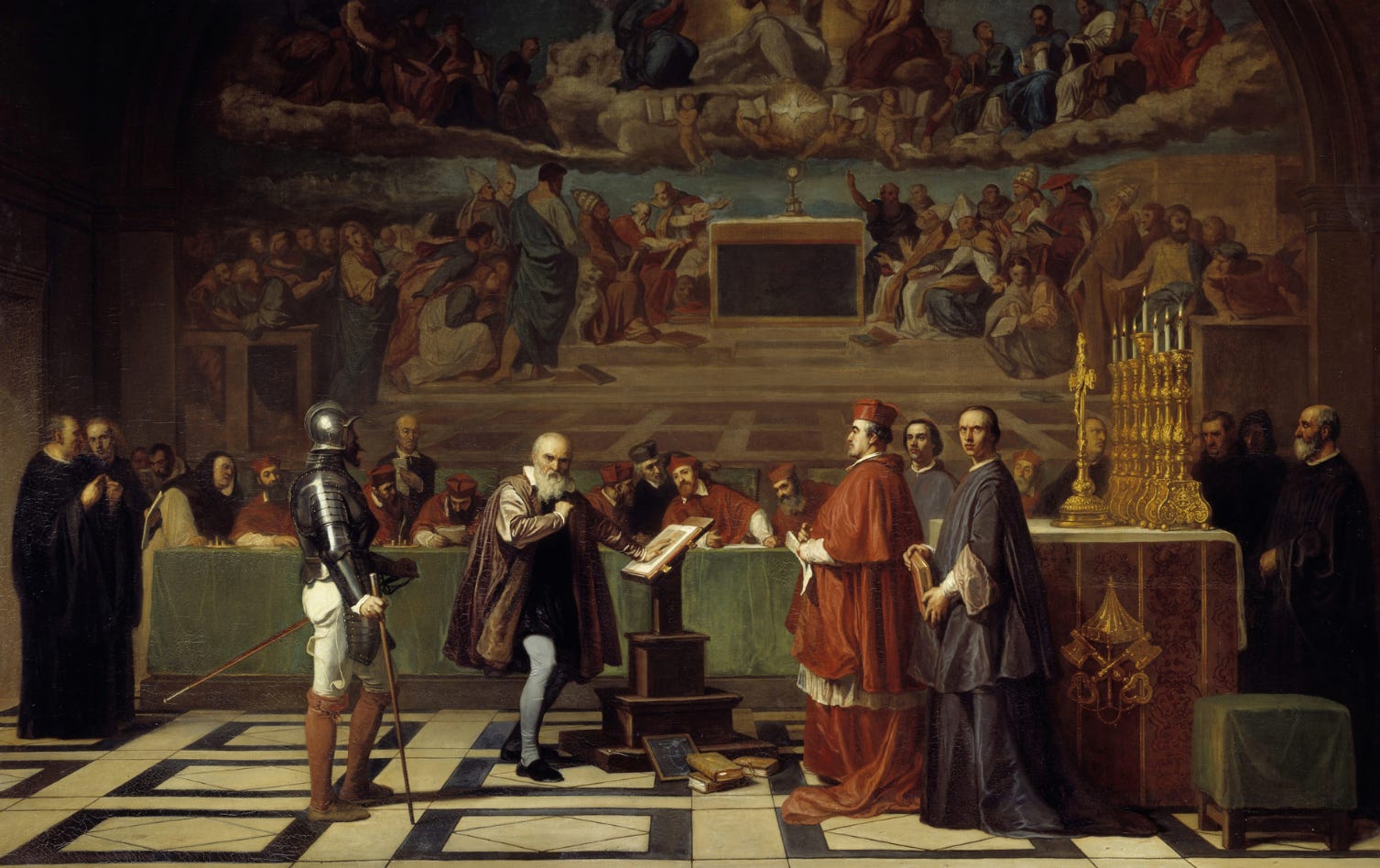
But, in 1633, the hammer fell. For mysterious reasons, an unsigned memorandum recording the pronouncements of the Inquisition in 1616 surfaced that contradicted the affidavit signed by Bellarmine. Galileo’s version said that he was merely forbidden from “holding or defending” the Copernican position, but the new memorandum stated that he was forbidden from holding, defending or teaching Copernicanism6. This would mean that the mere discussion of the Copernican model was in direct defiance of the Inquisition, and that Galileo had clearly violated it by publishing the Dialogue. Enraged, Pope Urban VIII ordered Galileo to come to Rome at once to stand trial before the Inquisition. The charge was not based on any question of science, philosophy or theology – it was only “vehement suspicion of heresy,” which required only proof that an official order had been disobeyed7. Even on this count, it was hard to convict in a fully honest sense, given that the signed affidavit was firmly on Galileo’s side. Nevertheless, acquittal was a nonstarter for the already embattled Church, which was clearly motivated by the Debunker’s urge to suppress inconvenient information regardless of its truth value. In the end, a settlement was reached, providing that Galileo would admit to some wrongdoing and receive a relatively lenient punishment. The punishment is legend: house arrest for the rest of his life. Of course, one has to be fair to the Church and admit that he did get off with a much better end than Giordano Bruno, another famous champion of Copernicanism who also published books defending heliocentrism (and in certain respects went even further than Galileo – openly suggesting that the sun was just a normal star and that other stars had planets harboring life). That unlucky heretic ended up publicly burned at the stake, at the hands of none other than Cardinal Bellarmine. It’s all relative.
Galileo relied on quantitative analysis, Luther on qualitative. Galileo was a (proto-) scientist, Luther a theologian. Galileo ultimately caved under pressure from authorities, admitting that on some level he had overstepped, while Luther refused to give an inch. But both shared one key quality: they published works that challenged the orthodoxy, inviting the wrath of the closed Debunkers. For closed Debunkers, as we’ve seen in the Luther and Galileo cases, the content of a statement that contravenes the status quo is of secondary importance to the fact that this contravention has occurred. Even when the results are not genocidal, as in the Albigensian Crusade, the underlying identification of “wrongthink” as a pestilence that must be extirpated, rather than as a legitimate signal of the potential need to update one’s epistemic model, remains the key marker of the closed Debunker mindset.
Roper, Lyndal. Martin Luther: Renegade and Prophet. The Bodley Head, 2016. p. 75.
Ibid. 77.
Drake, Stillman. Galileo. Sterling, 1980. p. 1.
Coyne, George V. “Galileo and Bellarmine.” The Inspiration of Astronomical Phenomena VI, ASP Conference Series, Vol. 441, edited by Enrico Maria Corsini. Astronomical Society of the Pacific, 2011. p. 5.
Joshua 10:12-14.
Drake 171.
Ibid. 195.