
Chapter 19: Everything Is Information
In which I start to get out over my skis


This is the nineteenth chapter of a book that currently has the working title Cataspectral. You can find the introduction and table of contents here.
At the outset of this chapter, I should provide a brief disclaimer: I am not an expert in anything, except perhaps certain legal aspects of Cayman Islands based venture capital and private equity funds (although my coworkers may disagree with such a characterization). If you have any doubt about some physics thing I say in the below, please assume I’m wrong and consult a legitimate source. That said, while I am on the side of science, I also believe that not holding a degree in physics should not prohibit me from engaging academically with it in good faith, even though I may be severely off the mark. I can’t honestly say that I’m excited to hear your critiques, but I would be disappointed not to receive them (since that would probably mean that nobody is reading this).
With that behind us, let’s be off.
Among the most important tasks of a physicalist Christianity will be to grapple with the issue of reductionist metaphysics. I will argue that reductionism is not necessarily wrong, just that the ontology commonly associated with it leaves out information, which I will further argue is the most fundamental element of reality. Reductionism is the conviction that any complex process can, in principle, be fully described with reference only to its simplest parts. This means that, in applying reductionism, it is critically important to define what the “simplest parts” at issue are. For naïve realists, the parts are elementary particles and forces. To be a reductionist of this type is to say that, for instance, a human is “nothing more” than a conglomeration of elementary particles directed by forces. If the only things that are fundamental are particles and forces, and if to be fundamental is to be real, then a human is only real by virtue of the fact that it is a conglomeration of particles and forces. Describe a human as anything more or less coarse-grained at your leisure – just know that, at the most real level, a human is nothing but a conglomeration of particles and forces, not importantly different from a clod of dirt.
The problem is that it does seem like there is some difference between a human and a clod of dirt. What is the thing that differentiates them, if the only real things are particles and forces? I say that there must be something else at play: information. Reductionism is a powerful and legitimate method of explanation, but it only points out that very different large-scale objects are actually made up of the same small-scale stuff, much like saying that all Lego models are made out of the same basic Lego bricks. What reductionism is not saying is that a completed Lego model and a box full of jumbled Lego bricks are just two arrangements of Lego bricks with no important differences. This is a fallacy that the philosopher Graham Harman calls “smallism.”
Smallism is a fallacy because it ignores the relationships between the parts, which are just as real and fundamental as the parts themselves; that is to say, it ignores information. There’s a quantifiable difference between a finished Lego set and a box full of Lego bricks, in that it would take many, many random “shakes of the tub,” so to speak, to get a fully assembled Ultimate Collector Series (to Lego nerds, “UCS”) Millennium Falcon. So, is it then a kind of miracle that thousands of manchildren the world over have been capable of constructing UCS Millennium Falcons and displaying them in their living rooms to the chagrin of their wives? No, obviously not. Smallism is wrong because there is clearly a difference between a tub of Lego bricks and a fully constructed UCS Millennium Falcon. The difference is the manual, which is to say, the set of particular correlations between the parts. This aspect is information, and it is crucial to a correct description of reality. Saying that a human is the result of a particular series of interactions among particles and forces is true, but saying that a human is “nothing but” particles and forces is technically not the case. It isn’t the case because there is something additional that is needed to make a human beyond the particles and forces: information about the particular set of correlations among them.
The laws of physics are a general set of rules describing the characteristics of different conceptual abstractions that can be employed to predict the behavior of systems. Smallism is wrong even in the classical world, since the laws are meaningless unless you input initial conditions to play forward following the laws. That is, in the classical world, knowing how a given system starts out will tell you all the information you need to be able to predict what actually happens using the laws.
But initial conditions plus the laws of physics only deterministically predict outcomes on the macro, seemingly classical scale of everyday life. Once you zoom down to the quantum level, things aren’t so easy. In the famous double slit experiment, photons are sent one at a time through two parallel slits in a barrier. If you measure the state of the particle as it passes through the slits, it will “choose” to go through either one slit or the other and will appear as a single point on the wall beyond. But if no measurement is taken at the slits, the particle will show up on the back wall as a smeared-out probability distribution of the different places it might have ended up. This is often taken to show that reality at the quantum level is fundamentally probabilistic: if you don’t take a measurement, all options are still “on the table” as to which observation you might actually have made had you taken that measurement.
Because there is no way to predict ahead of time what observation will end up being made beyond laying out the probabilities of all possible observations, merely stating the initial conditions of an experiment can’t generate the exact outcome ahead of time. Only once the experiment has been run can we look backward and see the particular interactions the particles actually enacted with their environment, including the measurement apparatus. This issue points to a serious problem with the classical view: what was formerly seen in the world of Newton as “matter” clearly isn’t as “material” as we thought, in that it doesn’t seem to exist in particle form with definite location until it is measured.
In the years since the quantum revolution, many people have grappled with the problem of how to re-anchor physics in the real world now that Newtonian billiard ball atoms have been dethroned as its most fundamental components. Stephen Hawking famously asked in A Brief History of Time, “Even if there is only one possible unified theory, it is just a set of rules and equations. What is it that breathes fire into the equations and makes a universe for them to describe?”1 In this, he echoed Bertrand Russell’s claim: “Physics is mathematical not because we know so much about the world but because we know so little; it is only its mathematical properties that we can discover.”2 Indeed, things like ‘matter’, ‘energy’ and ‘force’ are all abstract, mathematically defined concepts. They rely, as the physicist Eugene Wigner put it, on “regularities in the events in the world around us which can be formulated in terms of mathematical concepts with an uncanny accuracy.”
The zoo of fundamental particles found in the Standard Model of Particle Physics – the best tested physical theory in history to many decimal places – is an excellent description of the regularities we find in nature. But, the question is, what makes it different from any other model that could just as well have been the correct one? The physicist John Wheeler has a clear answer to this problem, known as the It-from-Bit (“IFB”) theory: information – that is, measurement – is more fundamental than objects. There is no “substance” prior to measurement, at least not one that the laws of physics describe; there is instead the potential for measurements and the set of measurements that in fact occur. What we know as the universe emerges from the set of measurements that are actually made. This is similar to the philosophical position known as Instrumentalism, which holds that science is just a tool that is used to predict future measurements, but here we are going a bit further, claiming not only that science is a model for prediction of measurements, but that it’s measurements “all the way down,” so to speak. Philosophers of science would call this a form of “ontic structural realism.” Measurements are the most basic ontological unit of reality.
Before fleshing out this idea, I should say more specifically what I mean when I say ‘measurement’: a measurement is the observation of some difference. The term that is usually employed in physics is ‘decoherence’, which is what happens when a probability distribution of what you might see resolves into the single outcome that you actually end up seeing due to entanglement of a quantum system with the surrounding environment. Measurement in this sense is just one system “learning” about another, meaning that one system changes its state due to the influence of some other system. In Season 7, Episode 13 of The Office, Michael Scott awaits the decision of the love of his life, Holly Flax, as to whether she will break up with her boyfriend, giving him the chance to swoop in. Before him are two boxes: one filled with champagne and other party paraphernalia, the other with breakdown-management gear like a sponge to soak up his tears. Before Michael learns of Holly’s decision, the two boxes remain closed, showing us the two possible measurements that might be taken; once Michael hears, he will open one, causing the system of the two boxes to reflect the state of Holly’s relationship. In this way, the Michael system has taken a measurement of the Holly system.
But quantum measurements have an added quality that differentiates them from classical probability measurements like a roll of the dice or Michael opening one of his happy/sad boxes. With dice, I can roll one die and get a six, but that six tells me nothing about what the other die will land on. In the quantum world, there are cases in which one measurement can tell you something about what the other will be; this is quantum entanglement. Quantum entanglement is the name for the strange (one might even say “spooky”) fact that, if you measure one of a pair of particles after they interact, the result of a later measurement performed on the other particle can be predicted with better-than-chance odds. In principle, you could instantly know what the state of a particle halfway across the known universe would be if you measured its entangled partner here on Earth. This is not because the observed state of the second particle is somehow already determined by the observed state of the first before the measurement is taken, like how you can predict the breakage pattern of the other half of a clay plate broken in two.3 It’s that the other half isn’t knowable by anyone who doesn’t have access to the information you have. The 2022 Nobel Prize was awarded for the confirmation that, indeed, the measurement of the second particle is nonlocally, instantaneously influenced by the measurement of the first – the states of the two particles are not locally foreordained during their prior interaction with each other. New information about the pair of particles (at least) becomes accessible to us once we measure it, and (at most) is literally generated at the moment we measure it.
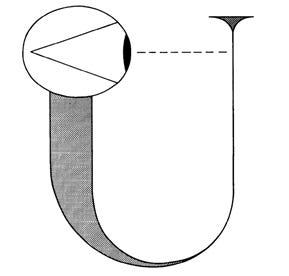
Now we return to where we left off – the idea that measurement is the best way of thinking about reality. The universe as understood by IFB is at its most basic level informational (that is, describable in terms of ‘bits’, ON/OFF switches or individual instances of difference). To talk about observations (meaning the observations of any observer, which I stress just means any measurement, including those of particles and other inanimate objects, not necessarily that of a conscious observer) is therefore a more fundamental way of talking about the boundary conditions or the laws of physics, since those do not exist definitely except by virtue of being observed. An event isn’t settled until it is measured, and this can only be done after the event has occurred from the perspective of the participants in the event. In other words, to discuss boundary conditions or laws is just a simpler way of discussing certain subsets of events; boundary-condition-talk and law-talk is reducible to measurement-talk. Wheeler famously illustrated the participatory nature of reality like so, with the U representing the universe, and the eye representing us looking out at what surrounds us:
The physicist Thomas Hertog, working with Stephen Hawking, has developed a philosophical stance toward cosmology that employs this kind of thinking to explain why the universe we observe exists in such an unlikely configuration, seemingly fine-tuned for life.4 He argues that we should reverse the explanatory pathway usually used in science, reasoning from effects to causes: given that we observe the kind of environment that we do, we must observe certain conditions in the early universe as boundary conditions (i.e. the conditions just after the Big Bang).
This is very similar to the anthropic principle, which holds that we can predict conditions of our universe on the basis that beings like us already exist in it and that we are average observers in the set of all possible observers. But it is different insofar as anthropic reasoning relies on the idea of the multiverse, which argues that there are literally infinitely many island universes out there with real observers. Claims about the existence of such island universes are not falsifiable, since we by definition won’t ever be able to test them by trying to see other universes. The anthropic principle also has questionable predictive power, since there is no clearly defined set of parameters that bound the set of universes fit for life. If your theory predicts some constant and gets it wrong, then – oopsie! – I guess that parameter isn’t as necessary for life as you thought, since obviously we wouldn’t be here if our universe weren’t fit for life! Furthermore, the multiverse would have to rely on a background rule set for how multiverses work – including the precision of the Big Bang – which is tailored to us existing in one of the infinite island universes, which just pushes the problem backwards one level without solving it.
Hertog’s spin on (or, depending on how you look at it, deflationary treatment of) anthropic reasoning is that our perspective as observers of the cosmos is inseparable from what we end up observing, and so the fine-tuning problem doesn’t arise in the first place. The only way the kind of universe we observe makes sense is if we admit that physics at the cosmic level is no less observer-dependent than it is at the quantum level. The universe’s evolution is path-dependent, meaning that every contingent interaction between quantum fields leads (and has always already led) the universe along one branch of a probability tree, closing off some possibilities for what will become real and leaving others open. The configuration of the universe as we now see it, including the laws of physics and the events just after the Big Bang, is predicated on a particular series of contingent quantum measurements, which could not have been predicted beforehand.

When our telescopes pick up photons generated billions of years ago that have bent around massive objects like galaxies through a process called gravitational lensing, the effect visible in the deep field image shown above, the beams of light could have taken many different paths around the objects. We are unable to determine which path a particular photon took until the moment of measurement. In that sense, when we measure it with our telescopes, we are determining the path that we will observe the photon having taken around the galaxy billions of years ago. Before we made that measurement, that information was inaccessible to us and perhaps could not even be said to have previously existed. In the same way, when we observe the photons in the cosmic microwave background, here in 2026 on planet Earth, we are taking measurements of those photons no less real than measurements taken at the time just after the Big Bang by other particles much closer to the action. In this way, what we observe now literally impacts the conditions we see in the distant past, making it less surprising that the conditions there seem to us fine-tuned for our existence. If they weren’t fine-tuned, we wouldn’t be here to observe them, and if we weren’t here to observe them, they might have evolved in a different way, leading to different observations than the ones we made.
Hertog takes this insight further with the idea that our everyday universe with three spatial dimensions and one temporal dimension may be holographically encoded on a lower-dimensional surface made up of quantum states taking the measure of one another, a process that can be described in terms of bits (bits in a quantum context are often whimsically called “qubits”). That is, what we experience as time and space are emergent properties of highly complex entanglements of quantum states that exist on a kind of outer shell, from which the universe we see projects inward. In principle, it’s no different from what makes holographic Pokémon cards or those goggles with 3D sharks or skulls on the lenses so cool.
This is one expression of what is known as the holographic principle, which holds that the amount of information in a given volume is encoded entirely on that volume’s surface. Originally, the holographic principle emerged as a way of resolving the paradox that black holes seem to destroy information in violation of the laws of thermodynamics; rather than destroy the information, it is argued, the black hole preserves it along its event horizon, effectively holographically encoding one of the dimensions of the infalling material. It turns out that, if you apply this principle to the entire universe, you end up with a very convenient way to restate the current laws of physics in a 2D space with negative curvature known as an Anti-de Sitter space. Annoyingly, our universe is closer to what is called a de Sitter space, as it is roughly flat. Hertog therefore defends a slightly different holographic theory in de Sitter space, seeing time as the emergent dimension.5
David Bohm, to whom we will return later, similarly held that the universe we see arises from an “implicate order” of entangled quantum states in which it is holographically encoded. Carlo Rovelli speaks of reality as, at its most basic level, a collection of relationships rather than independent objects. For Rovelli, any part of the universe only exists insofar as it is related to other parts. On this view, no complete understanding of the whole is possible from the point of view of any single part, only a synthesis of different points of view of the whole which always approaches but never reaches a complete understanding. It’s a bit like Gödel’s famous incompleteness theorem, which holds that for every consistent logical system there will always be true statements that cannot be proven within the system. As creatures “on the inside” of reality, then, we shouldn’t expect to be able to understand the whole as a totality; we will only ever be able to see it incompletely.
If it makes sense to speak of reality being a “whole,” then the most particular refers to the most holistic, and vice-versa. Thinkers of the Buddhist Madhyamaka and Huayan schools long ago came to the understanding of the world as holistic but also interdependent. The medieval Chinese philosopher Fazang relates this idea by comparing reality to a building, arguing that the rafter is the building and the building the rafter, since the building is not complete without the rafter, but the rafter is only a rafter insofar as it is part of the building. Perhaps even more redolent of the holographic principle (and more widely used illustratively) is the metaphor of Indra’s web, which is a net inset with a jewel at each intersection of strands. Each jewel only appears as it does because it reflects the jewels around it in a specific way based on where it is in the web, and the web as a whole depends on the mutual interactions of the jewels for its overall appearance.
The brilliant science fiction writer Ted Chiang renders something like this surprising involution in his story Tower of Babylon, although in the sense of literally “higher and lower” rather than the “macro and micro” sense with which we are concerned here. The story begins with a miner, Hillalum, of the land of Elam, who has been summoned along with his team by the builders of a great tower reaching to the heavens. When they arrive at the gates of Babylon, the gatekeepers greet them thus: “You are the ones who are to dig through the vault of heaven?” The journey to the top of the tower is long and wearying, passing eventually the moon and the sun in their courses until they finally reach the blank splendor of “the vault of heaven… a solid carapace enclosing all the sky.”6 After singing praises to Yahweh and making their sacrifices, the team begins the work of tunnelling into heaven. The way is slow, as they must take precautions against puncturing a reservoir, as it is well known that the vault of the sky holds back the waters above, which spill out as a Deluge when Yahweh wills it. Alas, their efforts are in vain, and the team is sundered by a rush of water. Miraculously, Hillalum survives, and makes it past the waters and into the light. But he is astonished and dismayed to discover that he has returned to his starting point, not far from the very tower by which he had ascended to the heavens. At first, he is puzzled, but then he arrives at a realization:
“It was as if [heaven and earth] lay against each other, though they were separated by many leagues… Men imagined heaven and earth as being at the ends of a tablet, with sky and stars stretched between; yet the world was wrapped around in some fantastic way so that heaven and earth touched. It was clear now why Yahweh had not struck down the tower, had not punished men for wishing to reach beyond the bounds set for them: for the longest journey would merely return them to the place whence they’d come... Thus would men know their place.”7
In the same way, we now find ourselves back at our origin as humans – as observers within the universe looking out and trying as best we can to understand. The lights along our way are the laws of physics that emerged in the vicinity of the point at which we lose the ability to observe anything at all: the Big Bang. What “breathes fire into the equations,” that is, what links math with the reality it describes, is the act of measurement. What is real is the particular set of interactions that has been observed historically, the most general description of which we know as “the laws of physics.” This rests implicitly on the chance instances of decoherence that led to the creation of the laws, the evolution of life and everything else – one real path within a vast, branching tree of theoretical possible histories. It can also help us to understand the meaning of our lives, as I will explain in the next chapter.
Hawking, Stephen. A Brief History of Time. Bantam, 1988. p. 174.
Russell, Bertrand. An Outline of Philosophy. Routledge, 2009. p. 164.
The word ‘symbol’ (syn- (together) -ballein (thrown)) comes from the ancient Greek practice of breaking clay tablets, so that two counterparties to a transaction would be the only ones who could fit them perfectly back together and thereby verify the message.
See generally. Hertog, Thomas. The Origin of Time. Bantam, 2023.
This was originally outlined in https://arxiv.org/pdf/hep-th/0106113 (Strominger 2001) and taken up further in https://arxiv.org/pdf/1111.6090 (Hartle Hertog 2012).
Chiang, Ted. Stories of Your Life. Vintage, 2002. p. 16.
Ibid. 28.