

This is the twelfth chapter of a book that currently has the working title Cataspectral. You can find the introduction and table of contents here.
The origins of Marxism-Leninism can be traced at least back to the French Revolution. It was there that the Rousseauian faith in the idea of a fully rational “General Will” fueled a vanguardist revolution, with its most radical wing dedicated to the complete elimination of class distinctions. The nineteenth century saw the rapid deployment of industrial capitalism across the Western world, generating huge numbers of urban proletariat, left alone in the dark, sooty cities after vacating their ancestral villages. As romantic nationalism was growing in intensity, so too was the broad constellation of socialist movements which sought to remedy the vast inequalities being produced by capitalism. Really, the one thing everyone could agree on was that capitalism was a problem; it was just as to what to do about it where people disagreed.
In the Russia of the nineteenth century, the pan-Slavic and Slavophilic nationalists and the more traditional socialist parties were joined by the diverse group of thinkers known as the Russian Populists.1 The Populists, which ran the gamut from anarchists like Mikhail Bakunin to thinkers more comfortable with the state like Nicholas Chernyshevsky, argued that Russia’s unique economic and political structure made the focus of traditional socialism on the fight between the urban proletariat and the bourgeoisie only tangentially applicable. Theirs was a fundamentally agrarian vision of socialism, taking the basic premises of equality and the rational ordering of society and applying them to what remained in large part a feudal, medieval system. The Populists saw in the Russian mir, the traditional peasant commune which was the basic social unit of most of the country, the seed of utopia, if only it could be saved from the depredations of capitalist industrialization. But these thinkers departed strongly from the Slavophiles in the type of reverence they held for the mir. Where the Slavophiles followed a path very similar to the romantic nationalists in Germany, worshipping the ever-suffering “Holy Russia” with its virtuous and simple people under the spiritual care of the Tsar,2 the Populists championed universal ideas, though this focus also at times took on a religious tenor.3
Many aspects of Lenin’s thought, particularly the more aesthetic and non-ideological parts of the Communist Party, could be traced from the Populists. Isaiah Berlin informs us that Chernyshevsky’s puritanical self-discipline, moral rigor and pedantry “set its seal on upon two generations of Russian revolutionaries; not least upon Lenin, who admired him devotedly.”4 Lenin’s 1902 book What is to be Done?, in which he argued that an intellectual vanguard was needed to prompt the proletariat to rise up in revolt, was named after Chernyshevsky’s utopian novel of the same name published in 1863. Another key Populist influence on Lenin, and Stalin by extension, was what came to be known as the “Nihilist” movement of the 1860s, which, it has been consistently noted, was in no way actually nihilistic. The description of this group of intellectuals as “nihilistic” was largely popularized by Western liberal journalists and other enemies who used it as a blanket term without bothering to truly understand the movement they were describing.5 The animating vision of the Nihilists was that the average person was trapped in a world of ignorance, and that the most important task was to liberate people first at an individual level, and later perhaps more generally, transmitting scientific knowledge and using such knowledge to improve material conditions. The transmission of scientific knowledge required dispelling the sentimental illusions of traditional religious belief; much art and custom also had to be done away with, as these did not help to progress economic growth or scientific knowledge and were thus useless.6 For some Nihilists, a scientific elite was required to jolt the process of a more general enlightenment, while others focused solely on casting off the shackles of irrationality and wastefulness at the individual level. The latter tendency led toward a kind of anarchism, the former poured into the gathering stream that would lead to Bolshevism.7
Russian Populism was not, in the end, the ideology that won the battle for Russia’s soul. That honor must go to Marxism, and specifically Marxism-Leninism. At least up to the middle of the twentieth century, Marxist historians would describe Populism as “a movement compounded of systematic misinterpretation of economic facts and social realities, noble but useless individual terrorism, and spontaneous or ill-directed peasant risings.”8 The attitude of Marxism-Leninism toward Populism can be compared to that of Christianity toward Judaism: a necessary precursor, but by no means the final word on the matter. The greatest prophet of that “final word” was, of course, Karl Marx, whose Communist Manifesto and Das Kapital formed what was effectively the gospels of Marxism-Leninism. In the 1870s and ‘80s, Marxism took off as an intellectual movement within the broader socialist milieu. It framed itself as a law-based, predictive science on the model of physics, deriding other socialist movements as utopian and detached from material facts. Friedrich Engels argued that previous thinkers had reached great insights into the errors inherent in the capitalist mode of production but that these were flukes in need of systematization and scientific grounding. The principles of scientific socialism were to be found “not in men’s brains, not in men’s better insights into eternal truth and justice, but in changes in the modes of production and exchange.”
Seeing itself as uniting all scientific inquiry within one high-level theoretical structure, Marxism relied on physics, chemistry, biology and related disciplines to explain the lower-order phenomena of the natural world. But the philosophical grounding beneath that science, the way that science was understood, varied widely among Marxists, at least at first. The starting point favored by Alexander Bogdanov, co-founder of the Bolsheviks, was a species of anti-metaphysics close to logical positivism developed by the great German physicist Ernst Mach. Known as “empirio-criticism,” it held that observations were the most fundamental datum of science, and that any statement about what was “real” prior to or outside of such observations was unscientific. Mach’s thinking would eventually inspire Einstein in the development of his theory of relativity, and it was also instrumental in the rise of quantum theory.
From Lenin’s point of view, empirio-criticism was tantamount to idealism, which holds that only the mind or spirit is real and that matter is illusory. After all, Marx and Engels had posited dialectical materialism, not dialectical observation-ism. Lenin held in his 1909 book Materialism and Empirio-criticism: Critical Comments on a Reactionary Philosophy that ‘matter’ just means “the property of being an objective reality, of existing outside our mind” (italics his).9 In response, Bogdanov insisted that Lenin was completely misunderstanding what he was saying; indeed, if all we mean by ‘matter’ is ‘mind-independent reality’, then, as the physicist Carlo Rovelli quipped, “even the Pope is a materialist.”10 But Bogdanov should have known that Lenin was unlikely to be convinced, given that he described Bogdanov’s theories in terms such as “a sheer “complex” of absurdities, fit only for deducing the immortality of the soul, or the idea of God, and so forth” (quotes his, used in order to make a pun on the word ‘complex’ which was a term of art used by Bogdanov).11 Unsurprisingly, Bogdanov was expelled from the Bolsheviks shortly after the publication of Materialism and Empirio-Criticism.
Of course, Lenin was motivated in part by his political interest in having control over the Bolsheviks, but he was no cynic. The force of his convictions is obvious in Empirio-criticism, and throughout the rest of his writings, and it is clear that Marxism (which had not yet curdled into Marxism-Leninism) was a cataspect for him just as it was for Bogdanov.
Bogdanov saw capitalism as alienating the worker, not just from the products of his labor, but from himself and his neighbors. Once socialism replaced capitalism, he looked forward to the shrinking of the self within the whole, making people “immortal” to the extent that they “develop their “I” beyond the limits of the individual and toward the workings of the community.”12 While Lenin was less psychological in his approach and rarely discussed the concept of death beyond the killing of enemies, it is easy to find similar signs of an outward lensing strategy in his body of work. In his short article “Prophetic Words,” written during the Russian Civil War in 1918, he paints the struggle to establish the dictatorship of the proletariat in apocalyptic terms:
“We are entitled to be proud and to consider ourselves fortunate that it has come to our lot to be the first to fell in one part of the globe that wild beast, capitalism, which has drenched the earth in blood, which has reduced humanity to starvation and demoralisation, and which will assuredly perish soon, no matter how monstrous and savage its frenzy in the face of death.”
Earlier in the same work, he compares the Marxist revolution to birth pangs, which surely wasn’t a conscious allusion to the twelfth chapter of the book of Revelation13: “Human child birth is an act which transforms the woman into an almost lifeless, bloodstained heap of flesh, tortured, tormented and driven frantic by pain. But…[w]ho would renounce love and procreation for this reason?”14 In his speech The Tasks of the Youth Leagues, Lenin derives a sense of unity from the class struggle of the proletariat and explicitly sets communist morality against the religious variety: “The old society was based on the oppression of all the workers and peasants by the landowners and capitalists. We had to destroy all that, and overthrow them but to do that we had to create unity. That is something that God cannot create.” In this same speech, he roots the importance of the individual in the collective struggle to achieve communism: “[t]his generation should know that the entire purpose of their lives is to build a communist society.” Elsewhere, he all but dubbed Marx a superhuman prophet: “The Marxist doctrine is omnipotent because it is true. It is comprehensive and harmonious, and provides men with an integral world outlook irreconcilable with any form of superstition, reaction, or defence of bourgeois oppression.” In short, Marxism provided a sense of cosmic meaning as felt through participation in a community destined to triumph over world-historic evil, and in doing so also offered a path toward consolation about death.
Unlike the Nazis, the Bolsheviks permitted no syncretism when it came to religion; nothing short of complete atheism was to be tolerated. This was true even before Stalin’s rise to power. In 1918, the Bolsheviks promulgated the Decree on Separation of Church and State, which abolished the traditional privileges of the Russian Orthodox Church and provided for the expropriation of all church property by the government. The process of expropriation set off a campaign of persecution, resulting in the deaths of hundreds of clerics and Christian laity, especially as random violence increased during the Russian Civil War.15
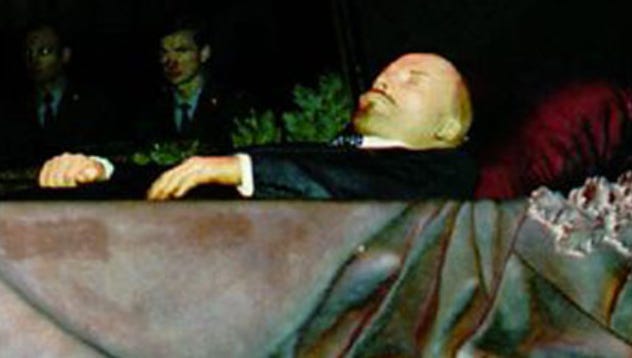
Lenin’s health began to decline during the waning phases of the war. After suffering multiple strokes, it was clear that the visibly frail Lenin was not long for this world. Stalin, then the General Secretary of the Communist Party, took advantage of this weakness to consolidate his own power within the machinery of state. Lenin aligned himself with an early hero of the war effort, Leon Trotsky, to attempt to head off Stalin’s power grab, even writing a warning against Stalin in 1922 called his “Last Testament.” Despite Lenin’s best efforts, Stalin was not to be denied. Even before Lenin died, Stalin’s even more authoritarian system was busy coming into being, and it made no bones about appropriating Lenin’s thought as the rigid dogmatism that was to be known as Marxism-Leninism. The symbolism of Lenin’s end would be struck from a script as being utterly ham-fisted: his corpse was to lie in state for eternity, entombed in a transparent box in which he would be preserved as an icon before the masses.
As the sole and absolute authority on Marxism-Leninism, which was in turn the science containing all sciences, Stalin’s approval was essential for any scientist or theory to advance. The government as well as the entire academic system was in his hands. Lenin’s relatively (and this term carries a lot of weight here) liberal Commissariat for Enlightenment was brought to heel, and a new system of Soviet technical institutes rose to complement the newly subservient role of science. In the Soviet Union of the 1930s, the “bourgeoisie intellectual” was replaced as the ideal type of knowledge producer by the folk engineer, the everyman who came to simple conclusions on the basis of good old common sense rather than abstruse, unnecessary philosophizing. A scientist’s job was not primarily to discover truth by way of basic research with no immediate industrial application, but rather to push forward the workers’ state by applying his methods to the efficient production of goods.
Trofim Lysenko16 was the perfect embodiment of this new proletarian scientist. He struck a figure not unlike that of a George Washington Carver or a Thomas Edison (…or perhaps an Elon Musk, or at least Musk’s own idea of himself) – the no-nonsense technician who cuts through the bullshit of the ivory tower to produce real results. It’s perhaps unsurprising that Stalin, being of humble origins himself, was drawn to such a figure. It helped that Lysenko rejected the neo-Darwinian paradigm that had taken root in the West, which combined Mendelian genetics and Darwinian natural selection and which, to Stalin, smacked of the bourgeois obsession with competition over unified self-development. Instead, Lysenko proffered a form of neo-Lamarckism in which there was no such thing as a physical “gene” that could be isolated as the physical mechanism of heritability. For Lysenko, the organism as a whole was the fundamental unit of biology, and it passed on a selection of its own characteristics (whether inherited or newly developed in interactions with the environment) in a way that was as-yet unknown and perhaps not even knowable in principle. The only problem was that Lysenko’s theories were manifestly wrong about how nature worked and so had no hope of producing the kinds of results he promised. Nevertheless, Lysenko quickly shot up through the ranks of the newly regimented Soviet system of technical institutes until his word was all but divine law. To deny the authority of Lysenko was to deny the authority of Marxism-Leninism and Stalin himself. The consequences for such denials ranged from academic censure to imprisonment. Unlike Carver or Edison, Lysenko’s success came not from results, but from political patronage.
Of course, there were things Stalin cared about more than strict conformity with the orthodoxy. Research into nuclear physics, tainted as it was by Lenin’s polemic against non-Newtonian paradigms (or, more precisely, his misunderstanding of what relativity and quantum mechanics really meant to say) in Empirio-criticism, was at first highly problematic. But as it became clear that such research would be necessary to counter the geopolitical threat of the United States, a compromise of sorts was reached. Advanced physics research could proceed, but only if it was couched in thick Marxist-Leninist terminology, making clear that it was in no way making claims implicitly or explicitly in line with the obviously erroneous bourgeois idealism peddled by Einstein, Heisenberg and Bohr. Happily, scientists who had previously stepped out of line could be kept in special-purpose work camps in which the “work” was scientific research; this was found to be such an efficient method of generating progress that it almost became preferable that scientists overstep their ideological bounds.
Unlike in the case of Nazism, which was defeated in combat, Marxism-Leninism collapsed under its own weight. The rise of Khrushchev offered a kind of false dawn in his denunciation of the oppression of the Stalin era and focus on building a more lenient culture. While the intensity of surveillance and arbitrary detention was reduced, the Gulag remained, as well as the general sense that to transgress the Party’s dogma on any given issue would put one in danger of going there. Marxism-Leninism lasted as the orthodoxy until the end came in 1991, although the worst governmental excesses stemming from Stalin’s personal paranoia died with him.
In retrospect, it seems obvious that the system was headed for disaster. In the world of geopolitical competition between industrialized state actors and smaller superhuman intelligences such as corporations or, in theory, artificial intelligences, accurate modeling of reality is ruthlessly selected for.17 Lenin spearheaded the establishment of a new orthodoxy and he then combined the organs of epistemic and political authority under it, but he strove to maintain some level of academic independence. Stalin opted to dissolve this meager boundary, placing the knowledge generating apparatus within the iron cage of Marxist-Leninist dogma and thus substantially depleting its ability accurately to model reality. If we aren’t careful, this is the fate in store for the United States in the not-too-distant future. This is where we will head in the next chapter.
Venturi, Franco. Roots of Revolution. Knopf, 1960. (consulted generally for background).
Arendt, Hannah. The Origins of Totalitarianism. Meridian, 1962. pp. 246-248.
Venturi 144.
Berlin, Isaiah. “Introduction” in Roots of Revolution (note 1).
Venturi 326.
Ibid. 325.
Ibid. 330.
Berlin xxviii.
Lenin, Vladimir. Materialism and Empirio-criticism. Chapter 5.2. (Accessed online at the extremely helpful marxists.org archive, linked above).
Rovelli, Carlo. Helgoland. Riverhead, 2021. p. 126.
Lenin, chapter 4.5.
Ings, Simon. Stalin and the Scientists. Atlantic Monthly Press, 2016. p. 52.
“And there appeared a great wonder in heaven; a woman clothed with the sun, and the moon under her feet, and upon her head a crown of twelve stars: And she being with child cried, travailing in birth, and pained to be delivered.”
“Prophetic Words.” Linked above (accessed at marxists.org archive).
Pospielovsky, Dimitry. Soviet Antireligious Campaigns and Persecutions. Palgrave Macmillan, 1988. p. 1. (but also consulted generally).
I consulted Ings for background on Lysenko throughout this section.
Accurate modeling only at the level of the state, corporation or AI, of course – not the level of the parts comprising these entities (i.e. people or chips). It’s unlikely that a state which devoted substantial resources to providing all citizens with the best possible model of reality would outcompete one that provided only the model of reality which, according to the higher-level model of the controlling intelligence, resulted in its citizens working harder in the service of its goals. See David Runciman’s excellent book The Handover for more on this.
This was a really nice read. The drama of the Bolsheviks and the formation of the Soviet Union is a fascinating history.
I think one of the biggest mistakes in Marxism is the idea that it is necessarily predictive. As an analytical tool for describing and understanding the history of the world through capital it is brilliant, but this unshakable faith that historical materialism could also accurately see what’s coming was (and continues to be) a dangerous tool in the hands of leaders.
I wish Lenin had been more open to some of the ideas of those early contemporaries, and wish Marx had taken more of the caution of prediction from Hegel.
I’m looking forward to the next chapter, that last bit hooked me into questioning where you’re heading with this.
Keep up the strong work!